


One of the most common patterns we see in retirement planning isn’t recklessness. It’s hesitation.
Many retirees delay important decisions because they’re waiting for certainty. They want to know what markets will do next year. They want clarity on future tax policy. They want reassurance that healthcare costs won’t rise faster than expected. They want guarantees.
But certainty rarely exists in retirement—or in life.
Markets change. Tax rules evolve. Interest rates shift. Personal priorities adjust. Health, family dynamics, and spending needs can all look different five years from now than they do today. Waiting for perfect clarity before making a move often means staying in limbo longer than necessary.
The reality is this: confidence and certainty are not the same thing.
The Illusion of Perfect Timing
It’s natural to want reassurance before making a major financial decision. Retirement represents a significant transition. Paychecks may stop. Income sources change. The financial decisions you make now can affect decades ahead.
But the idea that there will be a “perfect moment” to act—when markets are stable, tax laws are settled, and economic headlines are quiet—is largely an illusion.
Financial history shows us that markets experience cycles of growth and contraction. According to long-term data reviewed by firms such as Vanguard, volatility is a normal feature of investing, not an exception.¹ Waiting for volatility to disappear before adjusting a retirement strategy may mean waiting indefinitely.
Similarly, tax policy has shifted repeatedly over decades. Changes are part of the legislative process. The expectation that today’s rules will remain static throughout retirement is rarely realistic.
When retirees wait for certainty, what they’re often waiting for is relief from discomfort. But clarity does not come from eliminating uncertainty. It comes from understanding how to navigate it.
What Confidence Actually Means
Confidence in retirement planning does not require knowing exactly what will happen. It means understanding your options and having a framework that can adapt.
Confidence grows from:
-
Knowing where your income will come from
-
Understanding how your investments are structured
-
Being aware of tax considerations
-
Having contingency plans in place
-
Reviewing and adjusting over time
It’s less about predicting precise outcomes and more about preparing for a range of possibilities.
The Financial Industry Regulatory Authority (FINRA) emphasizes investor education as a core principle of responsible financial decision-making.² Education builds perspective. Perspective reduces fear. And, reduced fear allows decisions to be made thoughtfully rather than emotionally.
When retirees understand the mechanics of their strategy, they often feel more comfortable moving forward—even without guarantees.
Planning for Possibilities, Not Predictions
A common misconception about retirement strategy is that it should function like a forecast. In reality, effective planning resembles a flexible framework.
Instead of asking, “What will the market return next year?” a more constructive question is, “How does this plan function if returns are lower than average? Higher than average? Volatile?”
Instead of asking, “Will tax rates increase?” the better question becomes, “If tax rules change, how does this structure adapt?”
Instead of trying to determine exactly how long retirement will last, planning often considers longevity ranges and income sustainability under multiple scenarios.
By stress-testing a strategy across different possibilities, retirees reduce the need for perfect foresight. They don’t need to predict the exact path—only to know the plan can adjust.
This shift in thinking often brings noticeable relief. The focus moves from “What if something goes wrong?” to “If something changes, here’s how we respond.”
Why Waiting Can Create Its Own Risk
Delaying decisions while waiting for certainty can sometimes introduce unintended consequences.
Missed tax planning windows, delayed portfolio adjustments, or postponed income coordination strategies can limit future flexibility. While it’s wise to avoid impulsive decisions, extended hesitation may also carry opportunity costs.
Confidence doesn’t mean acting quickly. It means acting deliberately—once you understand the framework.
Thoughtful retirement planning replaces reactive decisions with proactive structure. Instead of responding to headlines, you respond to your plan.
A Calmer Way to Approach Uncertainty
The emotional weight of retirement decisions is real. For many individuals, retirement represents a shift from accumulation to distribution. That transition can feel irreversible.
But the most sustainable strategies are not built on one-time decisions. They’re built on ongoing review.
Markets evolve. Legislation changes. Personal circumstances shift. A structured planning process anticipates these adjustments rather than being surprised by them.
Confidence grows when retirees recognize that decisions today are not carved in stone. They’re part of a living system designed to evolve.
This is where thoughtful planning replaces hesitation with clarity.
Rather than trying to eliminate uncertainty, the goal becomes managing it. Rather than demanding guarantees, the focus shifts to building resilience.
Moving Forward Without Perfect Answers
You do not need complete certainty to move forward in retirement planning.
You need:
-
A clear understanding of your income sources
-
Awareness of your expenses and goals
-
A structured investment framework
-
Tax coordination awareness
-
A review process that adapts over time
When these elements are in place, confidence becomes less dependent on external events.
Headlines will continue. Economic data will fluctuate. Political debates will unfold. But your strategy does not need to react to every development.
Retirement planning is not about predicting the future with precision. It is about building flexibility so that the future—whatever it looks like—can be navigated thoughtfully.
Certainty is rarely available. Confidence, however, can be built.
And when confidence replaces the need for guarantees, retirement decisions often feel clearer, steadier, and far less overwhelming.
A Thoughtful Next Step
If you find yourself waiting for “more certainty” before reviewing your retirement plan, it may be helpful to pause and simply evaluate whether your current strategy is structured to adapt. A periodic review is not about reacting to headlines—it’s about ensuring your income, investment, and tax strategies remain aligned with your goals and stage of retirement.
At Heritage Financial Planning, we guide clients through our HFP S.T.A.R. Strategy—Seasonal Transition into Advanced Retirement—a structured, phase-based planning framework designed to help individuals navigate retirement transitions with clarity and flexibility. Rather than focusing on predictions, the S.T.A.R. Strategy emphasizes coordination, adaptability, and long-term sustainability across each stage of retirement.
If you would like a second perspective on your current plan—or simply a thoughtful conversation about how prepared your strategy is for different possibilities—we invite you to contact our office to schedule a retirement planning review. There is no pressure, just a professional discussion centered on helping you move forward with greater clarity and confidence.
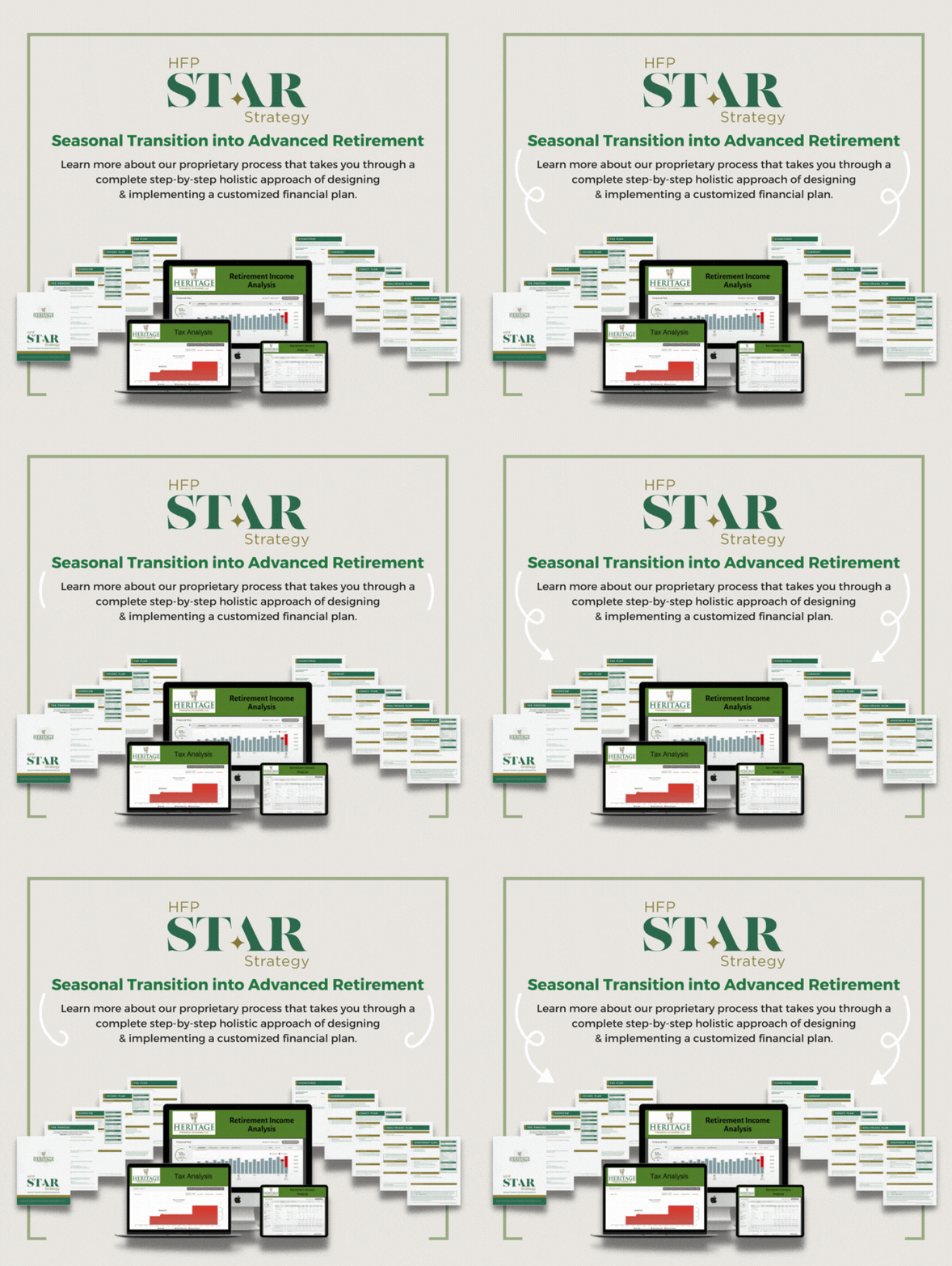
Click here to learn more about our HFP STAR Strategy process.
Sources:
- Vanguard – https://www.vanguard.com
- FINRA – https://www.finra.org