




Retirement is often viewed as a milestone—a finish line that marks the end of a career and the beginning of a new chapter. For many, it’s something to work toward for decades. There’s a specific date, a sense of arrival, and often a plan centered around what those first few years might look like.
But while that transition is important, retirement itself is not a single moment.
It is a phase—one that can last 25, 30, or even 35 years.
Understanding retirement as a long-term phase rather than a one-time event can change how planning decisions are made. It shifts the focus away from short-term preparation and toward building a strategy that can evolve over time.
Why the First Few Years Get the Most Attention
It’s natural to focus on the early years of retirement. These are often the most anticipated and the most active.
For many retirees, this period includes travel, hobbies, time with family, and the freedom to explore interests that were previously limited by work schedules. Financial planning during this stage often centers around ensuring there is enough income to support this lifestyle.
However, this focus can sometimes create an unintended gap in planning.
When too much attention is placed on the early phase, it can be easy to overlook how needs and priorities may change in later years.
How Retirement Evolves Over Time
Retirement is not static. It tends to unfold in stages, each with its own characteristics and financial considerations.
In the early years, spending may be higher due to travel and lifestyle activities. Flexibility is often a priority, and retirees may feel comfortable taking a more active role in managing their time and finances.
As retirement progresses, priorities often begin to shift. Travel may become less frequent, while healthcare and stability may take on greater importance. Spending patterns may change, and financial decisions may become more focused on maintaining consistency and security.
Later in retirement, simplicity often becomes more valuable. Managing income, coordinating healthcare costs, and ensuring that financial decisions remain aligned with long-term goals become key considerations.
These transitions are normal—but they require a plan that can adapt.
Why Longevity Changes the Planning Conversation
One of the most important factors influencing retirement planning today is longevity.
People are living longer than previous generations, which means retirement must be planned over a much longer time horizon. What once may have been a 10–15 year phase can now span multiple decades.
This extended timeline introduces new challenges.
Inflation, market fluctuations, healthcare costs, and tax changes all have more time to influence outcomes. A plan that works well in the first five years of retirement may need adjustments to remain effective over the next twenty.
This is why long-term thinking becomes so important.
Rather than trying to predict every future scenario, effective retirement planning focuses on building flexibility—allowing adjustments to be made as life evolves.
The Importance of Income Sustainability
When retirement is viewed as a multi-decade phase, income planning becomes less about a fixed number and more about sustainability.
It’s not just about how much income is available today—it’s about how that income can be maintained over time.
This includes considering how withdrawals are structured, how investments are positioned for both growth and stability, and how income sources interact with one another.
For example, relying too heavily on a single income source may create vulnerability if circumstances change. On the other hand, a diversified approach can provide greater flexibility and resilience.
Sustainable income planning is not static—it requires periodic review and thoughtful adjustments.
Why This Matters in Today’s Retirement Landscape
Today’s retirees face a financial environment that is more dynamic than ever.
Markets continue to evolve. Inflation impacts purchasing power. Healthcare costs remain an important consideration. Tax rules can shift over time.
At the same time, many individuals are responsible for managing their own retirement income rather than relying on traditional pension structures.
This combination means that retirement planning must be both proactive and adaptable.
A plan built only for the early years may not fully account for these long-term realities. Viewing retirement as an ongoing phase allows for a more comprehensive approach.
A More Adaptive Planning Approach
At Heritage Financial Planning, we help clients approach retirement as an evolving process rather than a fixed event.
Through our HFP S.T.A.R. Strategy (Seasonal Transition into Advanced Retirement), we guide individuals and families through the different stages of retirement, focusing on income planning, tax efficiency, risk management, and long-term clarity.
This structured approach allows for adjustments to be made thoughtfully over time, rather than reacting to changes as they occur.
The goal is not to create a plan that remains unchanged, but one that can evolve alongside your life.
Moving Forward with a Broader Perspective
Retirement is not defined by a single date on a calendar. It is a phase that unfolds over time, shaped by changing needs, priorities, and circumstances.
By approaching retirement with a long-term perspective, you can create a strategy that supports not just the first few years, but the decades that follow.
If your current plan is focused primarily on the early stages of retirement, it may be worth taking a broader look.
At Heritage Financial Planning, we work with individuals and families to build retirement strategies designed to adapt over time. Through our HFP S.T.A.R. Strategy, we provide a structured, personalized approach that helps bring clarity and confidence to every stage of retirement.
If you’d like to explore how your plan aligns with a long-term retirement strategy, we invite you to schedule a conversation with our team.
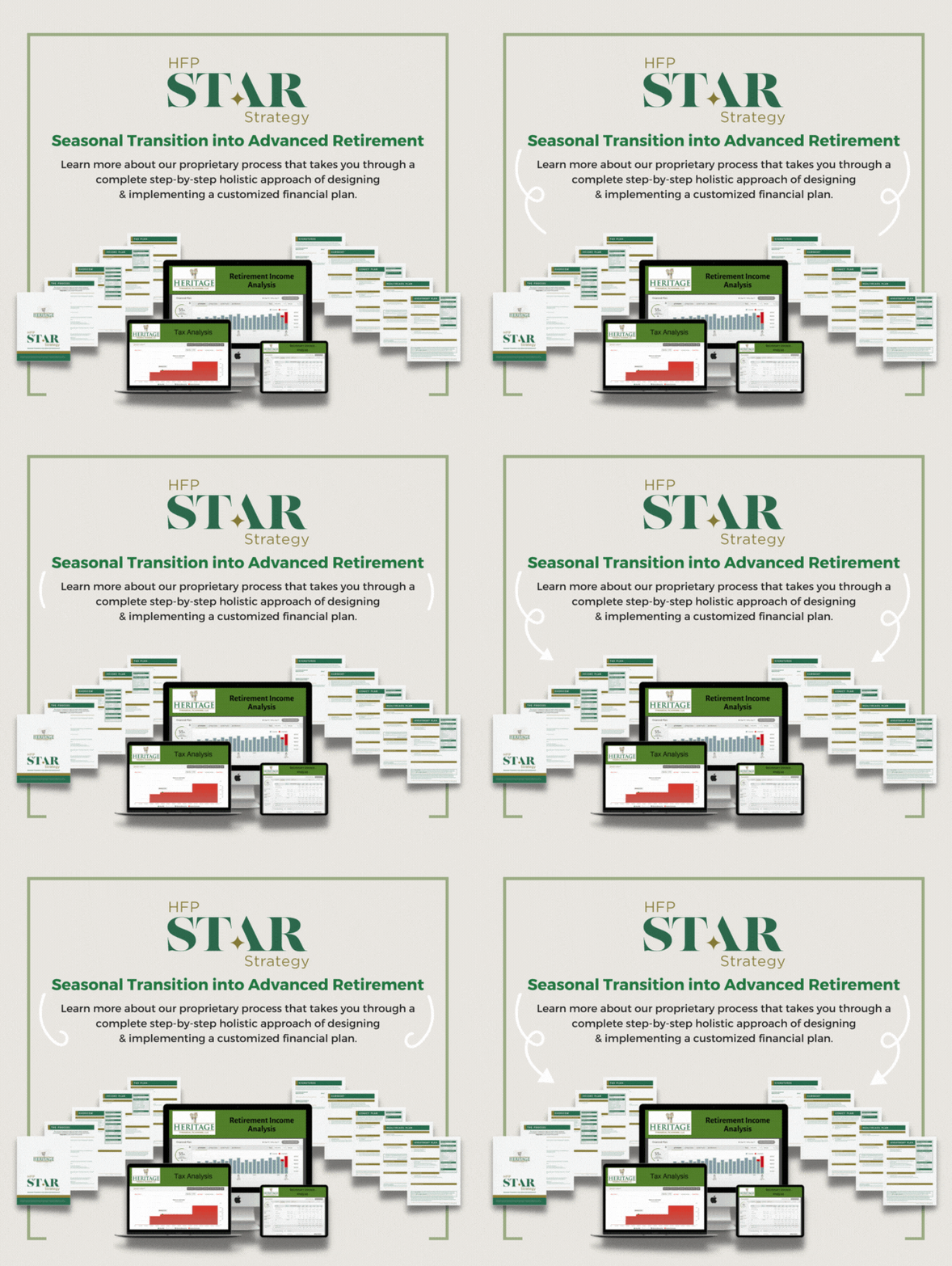
Click here to learn more about our HFP STAR Strategy process.
Sources:
1 . U.S. Census Bureau – Life Expectancy and Aging Trends
https://www.census.gov/topics/population/age-and-sex.html
2 . Vanguard – Planning for a Long Retirement
https://investor.vanguard.com/investor-resources-education/retirement
3 . Fidelity Investments – How to Plan for a Long Retirement
https://www.fidelity.com/viewpoints/retirement/long-retirement