




If you’ve spent any time reading financial headlines, you’ve probably seen articles suggesting that you need a specific dollar amount—often $1 million or more—to retire comfortably. While these figures generate attention, they rarely tell the full story.
The truth is that retirement planning is far more personal than any single number can represent. Every family has different goals, spending habits, retirement timelines, and sources of income. Rather than focusing on an arbitrary savings target, we believe it’s more valuable to build a comprehensive retirement strategy that reflects your unique financial picture and long-term objectives.
At Heritage Financial Planning, our goal is to help clients move beyond chasing a “magic number” and instead develop a practical roadmap designed to support the retirement they envision.
Retirement Is About Income, Not Just Assets
One of the biggest misconceptions about retirement is that success is measured solely by the size of your investment accounts.
In reality, what matters most is whether your retirement income can reliably support the lifestyle you want to enjoy throughout retirement.
Several factors influence how much you’ll actually need, including:
- Where you plan to live during retirement
- Your expected monthly living expenses
- Healthcare and long-term care considerations
- Travel, hobbies, and lifestyle goals
- Whether you plan to continue working part-time
- Expected Social Security benefits
- Pension income or other guaranteed income sources
- Rental properties or other passive income
Because every retirement is different, two households with identical account balances may have dramatically different levels of financial security. One family may require substantially more income than another, while someone with multiple income sources may need to rely less on investment withdrawals.
That’s why we encourage clients to focus less on reaching a particular account balance and more on answering a much more meaningful question:
Will my after-tax income be enough to comfortably support the retirement I want?
Building a Retirement Roadmap
A successful retirement plan begins by understanding your vision for the future.
Before discussing investments or account balances, we first work to understand what retirement looks like for you.
Some of the questions we explore include:
- When would you ideally like to retire?
- Would you prefer a gradual transition into retirement or stop working completely?
- What type of lifestyle do you hope to maintain?
- Do you plan to relocate?
- How much travel or leisure spending do you anticipate?
- What financial priorities matter most to you and your family?
Once these goals are established, projected retirement expenses can be estimated using today’s dollars and adjusted over time to account for inflation. This creates a more realistic picture of future spending needs instead of relying on rough estimates or generalized rules of thumb.
Identifying Reliable Retirement Income Sources
The next step is understanding where your retirement income will come from.
Most retirees receive income from multiple sources rather than relying on a single investment account. These may include:
- Social Security retirement benefits
- Employer pensions
- Individual retirement accounts (IRAs)
- 401(k) and other workplace retirement plans
- Taxable investment accounts
- Annuities
- Rental income
- Part-time employment
- Other personal assets
Each income source may have different tax implications and different timing considerations.
For example, determining when to begin claiming Social Security benefits can significantly affect lifetime retirement income. Likewise, coordinating withdrawals from taxable, tax-deferred, and tax-free accounts may help improve tax efficiency over the course of retirement.
Looking at these income sources together—not independently—helps create a more coordinated retirement strategy.
Evaluating Your Current Savings Strategy
Once future income needs have been identified, it’s important to evaluate whether your current savings are positioned to support those goals.
This involves reviewing:
- Retirement account balances
- Taxable investment accounts
- Cash reserves
- Investment allocation
- Ongoing contribution levels
- Employer retirement benefits
- Other long-term assets
The objective isn’t simply accumulating the largest possible account balance. Instead, it’s ensuring your savings strategy aligns with your anticipated retirement income needs and overall financial objectives.
Sometimes relatively small adjustments—such as increasing savings, revisiting investment allocations, or adjusting retirement timing—can have a meaningful impact over many years.
Stress Testing Your Retirement Plan
No retirement unfolds exactly as planned.
Markets fluctuate, inflation changes purchasing power, tax laws evolve, healthcare expenses may increase, and life circumstances often shift over time.
That’s why a comprehensive retirement plan should be designed to evaluate multiple scenarios rather than relying on a single projection.
At Heritage Financial Planning, we believe retirement planning should account for a variety of possibilities, including:
- Retiring earlier than expected
- Delaying retirement
- Lower-than-expected investment returns
- Higher inflation
- Increased healthcare costs
- Longer life expectancy
- Changes in spending patterns
- Unexpected financial events
Testing different outcomes helps identify potential risks before retirement rather than reacting to them afterward. It also provides greater confidence that your overall strategy can adapt as circumstances change.
Why Your Planning Years Matter Most
For many individuals, the years between ages 35 and 55 represent one of the most valuable opportunities to strengthen long-term retirement readiness.
During this period, there is often still sufficient time for strategic adjustments to make a significant difference over the coming decades.
Increasing retirement contributions, improving tax efficiency, optimizing investment diversification, or refining retirement goals during these years can potentially improve future financial flexibility.
It’s also a time when financial conditions outside your control continue to evolve. Tax legislation, Social Security rules, interest rates, inflation, and market conditions all change over time. Regular reviews help ensure your retirement strategy remains aligned with both your goals and today’s economic environment.
Rather than creating a plan once and placing it on a shelf, retirement planning works best as an ongoing process.
Navigating Today’s Retirement Landscape
Today’s retirement environment presents both opportunities and challenges.
After many years of historically low interest rates, higher bond yields may offer additional income opportunities for certain investors seeking diversification and income generation. At the same time, inflation continues to remind retirees that maintaining purchasing power remains an important long-term objective.
Balancing income needs with long-term growth potential requires thoughtful planning.
Maintaining appropriate exposure to growth-oriented investments may help offset inflation over time, while more conservative investments can play an important role in helping manage risk and generate income. The appropriate balance depends on each individual’s financial goals, time horizon, and risk tolerance.
Having a written retirement strategy provides perspective during periods of market volatility. Instead of making emotional decisions based on headlines, investors can evaluate market movements within the context of their long-term financial objectives.
A Personalized Retirement Strategy Provides Confidence
Retirement planning shouldn’t be about chasing someone else’s number.
It should be about creating a strategy that reflects your lifestyle, your priorities, your resources, and your future goals.
When your retirement plan is built around projected income, realistic expenses, tax considerations, and ongoing adjustments, financial decisions become more intentional and less overwhelming.
A personalized roadmap doesn’t eliminate uncertainty, but it can provide greater clarity, confidence, and direction as you move toward retirement.
How the HFP S.T.A.R. Strategy Helps You Prepare for Retirement
At Heritage Financial Planning, we understand that retirement is much more than reaching a savings goal. It represents one of life’s biggest transitions, requiring thoughtful coordination across every aspect of your financial life.
That’s why we’ve developed our proprietary HFP S.T.A.R. Strategy® (Seasonal Transition into Advanced Retirement). Rather than focusing on investments alone, this comprehensive planning process is designed to guide clients through each stage of retirement preparation by integrating income planning, investment management, tax-efficient distribution strategies, Social Security timing, Medicare considerations, risk management, and legacy planning into one coordinated retirement strategy.
As your life evolves, your retirement plan should evolve with it. The HFP S.T.A.R. Strategy emphasizes ongoing reviews and proactive adjustments so your financial decisions continue supporting your long-term goals through changing markets, tax laws, and personal circumstances.
If you’re ready to move beyond guessing at a retirement “magic number” and start building a personalized roadmap designed around your unique goals, we’d love to help. Contact Heritage Financial Planning today to schedule an appointment and learn how our HFP S.T.A.R. Strategy can help you prepare for a more confident retirement.
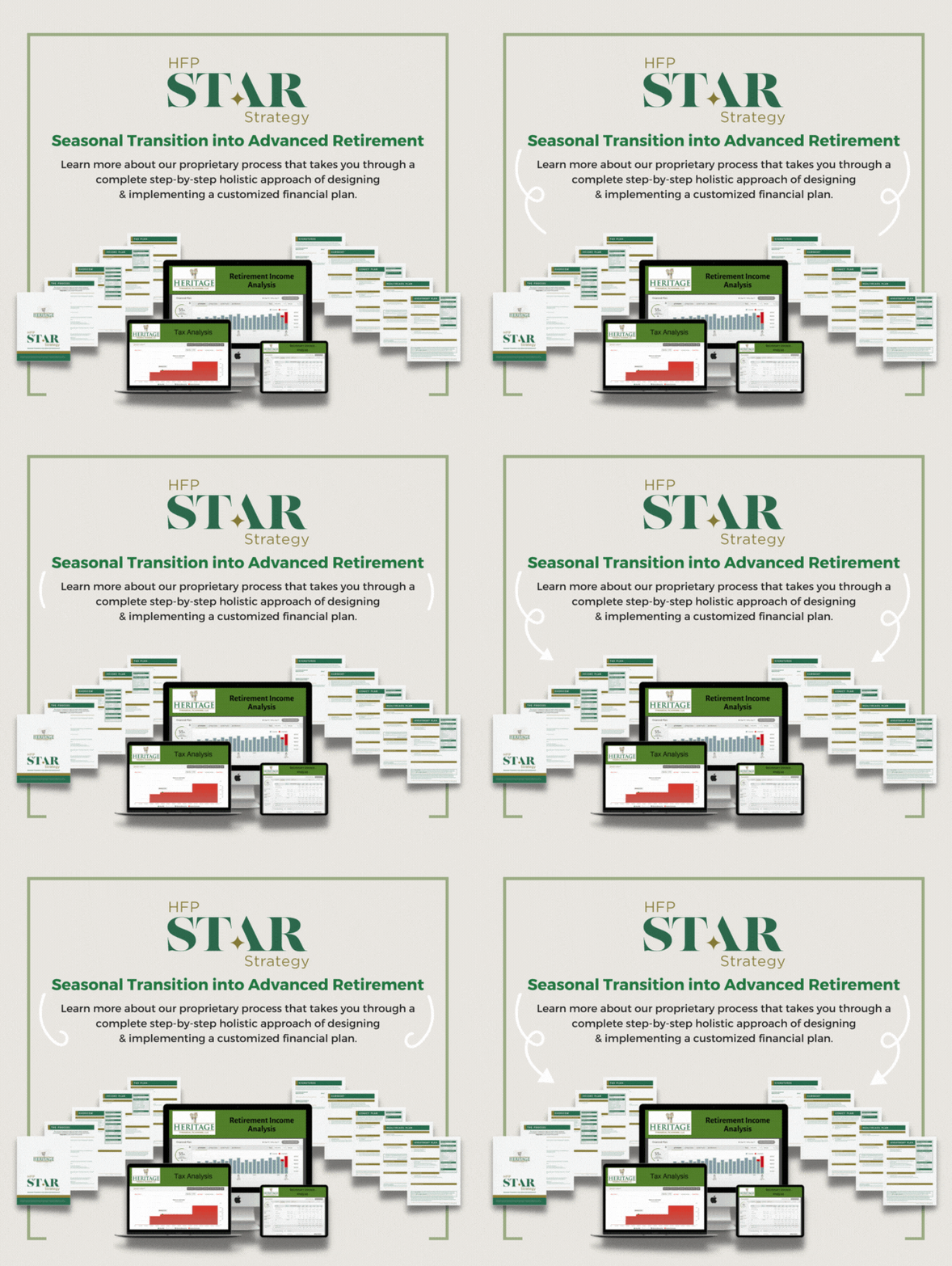
Click here to learn more about our HFP STAR Strategy process.
Sources:
- Social Security Administration. Retirement Benefits. https://www.ssa.gov/retirement
- U.S. Department of Labor. Saving Matters: Retirement Planning. https://www.dol.gov/general/topic/retirement/saving
- Employee Benefit Research Institute (EBRI). Retirement Confidence Survey (Latest Edition). https://www.ebri.org/retirement/retirement-confidence-survey
- J.P. Morgan Asset Management. Guide to Retirement. https://am.jpmorgan.com/us/en/asset-management/adv/insights/retirement-insights/guide-to-retirement/
- Heritage Financial Planning. HFP S.T.A.R. Strategy (Seasonal Transition into Advanced Retirement). https://heritagefinancialplanning.net/about/heritage-financial-star-strategy/