




When long-term care planning comes up, the conversation often goes immediately to insurance.
“Should I buy long-term care insurance?”
That can be an important question. But it should not necessarily be the first question.
A more useful starting point may be:
“If I eventually need long-term care, where would the money come from?”
Insurance is one potential answer. It is not the only one. Depending on your age, health, assets, income, existing coverage, family situation, and retirement goals, your long-term care funding strategy may involve several different resources. The objective is not automatically to purchase a product. It is to build a plan.
Traditional Long-Term Care Insurance
Traditional long-term care insurance is specifically designed to help pay for qualifying long-term care expenses under the terms of the policy. Coverage varies significantly by contract. Policies can differ in benefit amounts, benefit periods, waiting periods, inflation protection, covered services, eligibility requirements, and premiums. Age and health at the time of application can also affect availability and cost.
For some retirees or pre-retirees, traditional coverage may help transfer a portion of the financial risk associated with future care. For others, premiums, health considerations, existing assets, or other factors may make a different strategy more appropriate. This is why insurance should be evaluated within the retirement plan rather than in isolation.
Hybrid Life Insurance and Long-Term Care Strategies
Another category involves policies that combine life insurance with long-term care-related benefits. Depending on the specific contract, qualifying long-term care needs may allow access to certain benefits during the insured person’s lifetime, while remaining benefits may potentially be available to beneficiaries after death. These products can vary considerably. Costs, guarantees, benefit triggers, surrender provisions, death benefits, and long-term care features should all be reviewed carefully.
The fact that a product combines multiple benefits does not automatically make it better. It simply gives retirees another potential tool to evaluate.
Self-Funding From Savings and Investments
Some households may choose to self-fund some or all of their future care.
This generally means relying on assets such as:
Cash.
Investment accounts.
Retirement accounts.
Other savings.
Ongoing income.
For households with substantial resources, self-funding can provide flexibility. But it also means accepting the financial risk personally. A retirement strategy should therefore examine what a significant care expense could do to portfolio sustainability, taxes, the healthy spouse’s security, and legacy goals.
The question isn’t simply:
“Do we have enough assets?”
It is:
“What happens to the rest of our retirement if we have to use those assets for care?”
Retirement Income May Help Cover Part of the Cost
Some care expenses may be paid from existing retirement income.
Social Security.
Pension income.
Annuity income.
Portfolio distributions.
Required Minimum Distributions.
Other recurring income.
How much of the cost these resources can cover will depend on the household.
A retiree whose recurring income already exceeds normal living expenses may be in a very different position from someone whose monthly income is fully committed to existing expenses. Understanding your baseline cash flow is therefore an important first step in evaluating care funding.
Home Equity May Be Part of the Picture
For many retirees, their home is one of their largest assets. That means home equity may eventually become part of a long-term care conversation. A home could potentially be sold if someone permanently moves to another care setting. A couple might downsize.
Other strategies involving home equity may be considered depending on circumstances. But housing is emotional as well as financial. The fact that equity exists does not mean a retiree will want—or be able—to access it when care is needed. That is why relying entirely on the home as a long-term care plan can create limitations.
Family Resources Can Help—But Shouldn’t Be Assumed
Some families plan to provide care themselves. Others expect adult children to help financially. That may work. But family circumstances can change. Children have careers. They may live in another state. They may be raising their own children. They may have health issues or financial responsibilities of their own. A stronger plan defines what family members realistically can and want to do rather than simply assuming they will be available.
Medicaid May Provide Support for Eligible Individuals
Medicaid is a significant payer of long-term services and supports in the United States. Coverage may include services in institutional and certain home- and community-based settings for individuals who meet applicable eligibility requirements. Eligibility rules are complex and can vary by state and program. That means Medicaid should be understood as an important public resource—not assumed to be an automatic long-term care solution for every retiree. Families who believe Medicaid may eventually become relevant should seek qualified guidance before making major financial decisions.
Medicare Is Not Long-Term Care Insurance
Medicare may cover certain short-term skilled services when its requirements are met. It generally does not pay for ongoing custodial long-term care when that is the only care required. That distinction makes it especially important to identify other potential funding sources. A retirement plan based on the assumption that Medicare will pay for years of personal assistance could have a significant blind spot.
The Best Strategy May Use More Than One Resource
Long-term care planning does not have to be all-or-nothing. A household might use insurance to cover part of the potential cost while retaining assets for additional expenses. Another might self-fund early care and preserve insurance for more significant needs. Others may rely on retirement income, savings, home equity, and family assistance in combination. The appropriate mix depends on the individual. This is where financial planning becomes particularly valuable. Instead of asking which single product solves the problem, consider how multiple resources might work together.
Start With the Retirement Plan
Before deciding how to fund long-term care, look at the rest of your retirement.
How much income do you need?
How much liquidity do you have?
How much investment risk are you taking?
What tax consequences could larger withdrawals create?
How financially dependent is your spouse?
What legacy goals matter to you?
What insurance do you already own?
Where do you want to receive care?
The answers can help determine how much long-term care risk you can reasonably retain and how much you may want to transfer through insurance or another strategy.
Funding Future Care Through the HFP S.T.A.R. Strategy
At Heritage Financial Planning, we believe long-term care decisions should be evaluated as part of your complete retirement picture. Our proprietary HFP S.T.A.R. Strategy (Seasonal Transition into Advanced Retirement) integrates:
Income Planning
Age-Appropriate Investment Strategies
Tax Planning and Positioning
Healthcare Strategies
Legacy Planning
A long-term care funding decision can affect every one of these areas. Insurance premiums affect cash flow. Self-funding can affect investments. Retirement-account withdrawals can affect taxes. Care needs influence healthcare planning. And money spent on care may affect what eventually remains for beneficiaries.
That is why our starting point isn’t automatically an insurance policy. It is your retirement plan.
If you’re unsure how you would pay for long-term care if the need arose, contact Heritage Financial Planning to schedule an appointment. Our team can help you evaluate your current resources, potential risks, and available strategies through the broader framework of the HFP S.T.A.R. Strategy.
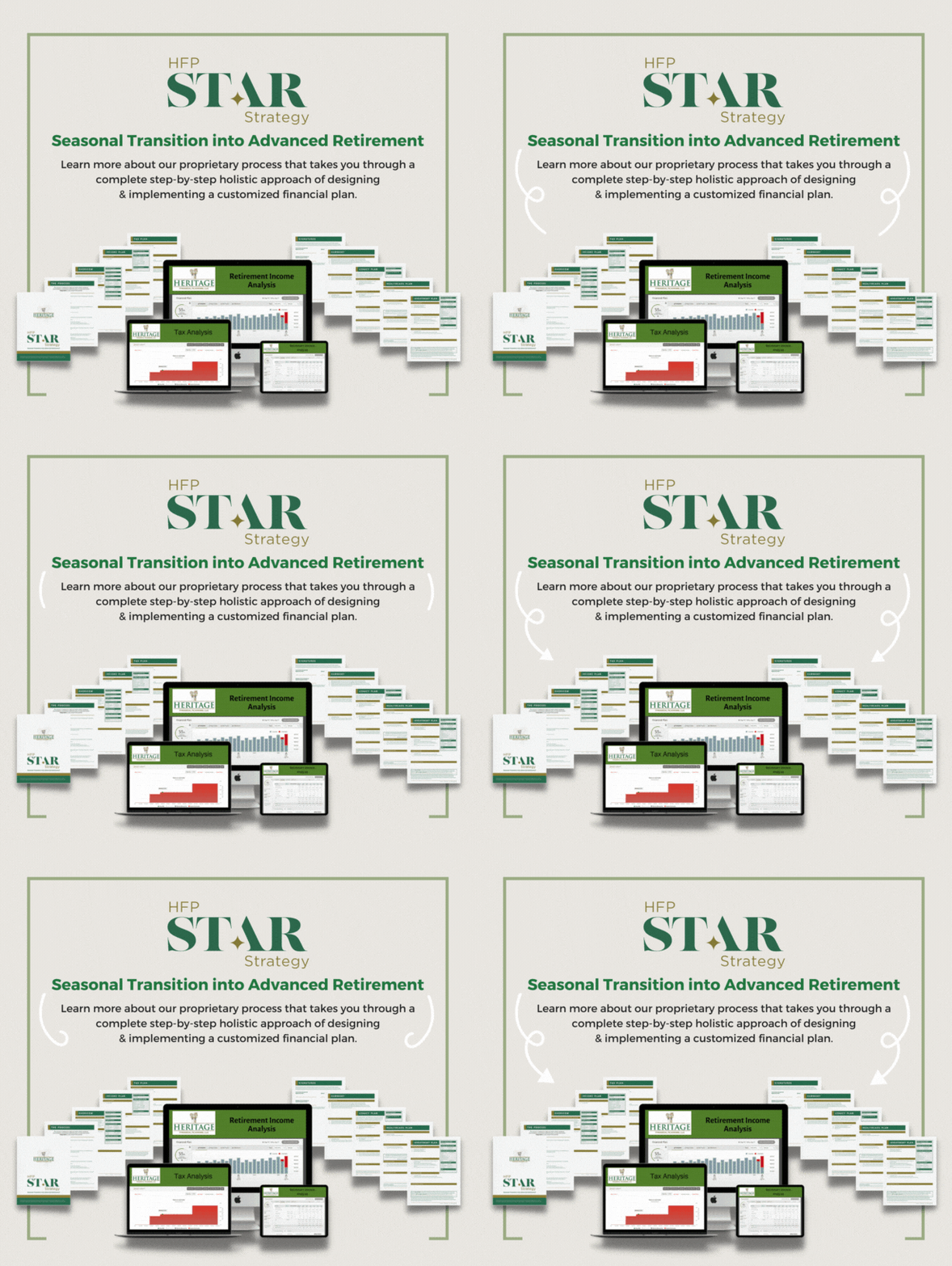
Click here to learn more about our HFP STAR Strategy process.
Sources:
1. Medicare.gov — Long-Term Care Coverage— https://www.medicare.gov/coverage/long-term-care
2. Medicaid.gov — Long-Term Services & Supports— https://www.medicaid.gov/medicaid/long-term-services-supports
3. Heritage Financial Planning — Long-Term Care & Retirement Planning Resources— https://heritagefinancialplanning.net/