




When couples plan for retirement, they usually plan together. They imagine where they will live, how much income they will need, when they will claim Social Security, how they will spend their time, and what they hope to leave behind.
But there is another scenario worth planning for: What happens if one spouse remains relatively healthy while the other requires long-term care?
It can be one of the most financially and emotionally challenging situations a retired couple faces. The issue is not simply how to pay for care. It is how to pay for care while continuing to protect the retirement of the spouse who does not need it.
One Household Can Suddenly Have Two Sets of Expenses
Before care is needed, a couple may share one home and many household expenses. Then one spouse requires assisted living, memory care, nursing care, or substantial in-home assistance. The couple’s finances can change dramatically.
If one spouse moves to a care facility, the other may still need to maintain the original home. That means the household could effectively be supporting two living arrangements.
Property taxes continue. Insurance continues. Utilities and maintenance continue. The healthy spouse still needs groceries, transportation, healthcare, and discretionary income. Meanwhile, the other spouse now has care expenses.
This is why long-term care costs should not be evaluated in isolation. The broader question is whether the retirement plan can support both spouses simultaneously.
Staying Home Can Be Expensive, Too
Facility-based care is not the only scenario. Many couples hope to care for each other at home for as long as possible. That can work well, particularly during the early stages of a care need.
But the healthy spouse may gradually become a full-time caregiver. They may need help with bathing, dressing, transportation, medication management, meal preparation, household tasks, or supervision.
Eventually, professional assistance may be needed. Home modifications could also become necessary. So while remaining at home may be the preferred option, it should not automatically be treated as the free option.
Retirement Withdrawals May Need to Increase
A significant care expense may require a couple to take more money from retirement accounts or investment assets. That can create several secondary effects.
Larger withdrawals may reduce assets available later in retirement. If withdrawals come from tax-deferred accounts, they may increase taxable income. Selling investments could alter the portfolio. Using large amounts of cash could reduce emergency reserves.
The couple may also become more financially vulnerable to future market declines or unexpected expenses. That is why the source of care funding can matter almost as much as the cost.
The Healthy Spouse Still Has a Retirement to Fund
This point deserves special attention. When one spouse develops significant care needs, families naturally focus on that person. But the other spouse may live for many more years.
They still need income. They may eventually require care themselves. They may need to replace a vehicle, repair a home, travel to see family, or handle unexpected expenses.
A plan that spends aggressively on one spouse’s care without considering the survivor’s long-term financial security can create a second problem later.
Long-term care planning for couples should therefore ask two questions:
What happens if I need care?
And:
What happens if my spouse needs care?
The answers may be very different.
Family Caregiving Has Financial Consequences
The healthy spouse may initially provide much of the care personally. Adult children may also help. That support can be invaluable.
But caregiving can carry costs that do not appear on a medical bill. A spouse may experience physical exhaustion. An adult child may reduce work hours. Family members may travel frequently. Caregivers may need respite services. Household responsibilities that were once shared may need to be outsourced.
Long-term care planning should therefore consider the broader family impact, not simply the direct cost of professional care.
Medicare Has Important Limits
Couples should also understand that Medicare generally does not pay for ongoing custodial long-term care when that is the only care required.
Medicare may cover qualifying short-term skilled nursing or certain home healthcare services under specific conditions. But ongoing help with everyday activities such as bathing, dressing, and eating is generally outside Medicare’s long-term coverage.
Assuming Medicare will absorb most future care costs can therefore leave a substantial gap in a couple’s retirement strategy.
Medicaid Can Affect the Conversation
Medicaid is a major payer of long-term services and supports for eligible individuals. For married couples, Medicaid eligibility and spousal financial protections can become particularly complex.
Rules can depend on state programs, income, assets, care settings, and other circumstances. Families facing potential Medicaid eligibility should seek current information and appropriate professional guidance rather than making major transfers or financial decisions based on assumptions.
Planning before a crisis can be especially important because hurried decisions can have unintended financial consequences.
Housing May Need to Be Reconsidered
Long-term care can also change the meaning of “home.” A house that worked perfectly at 65 may become challenging later.
Stairs. Bathrooms. Narrow doorways. Maintenance. Distance from healthcare. Transportation.
The healthy spouse may also decide that maintaining a large home no longer makes sense if the other spouse moves permanently to a care setting. Housing decisions can therefore become both emotional and financial.
Considering these possibilities before they are necessary gives couples more time to discuss what each person would want.
Estate and Legacy Goals May Change
A couple may enter retirement hoping to leave a substantial inheritance. Then years of care expenses change the financial picture.
That can be disappointing, but retirement assets have an important first responsibility: supporting the people whose retirement they were accumulated to fund.
Legacy goals should therefore remain flexible. The goal should not be preserving an inheritance at the expense of the financial security of either spouse. Instead, a retirement strategy can periodically reassess what is realistic as health, spending, and family circumstances evolve.
Create a “One Spouse Needs Care” Scenario
One of the most useful planning exercises couples can complete is a simple stress test. Imagine that one spouse begins requiring substantial care several years from now.
Then ask:
- Where would the care occur?
- What might happen to household expenses?
- Which assets would be used first?
- How might withdrawals change?
- What insurance coverage exists?
- Would the healthy spouse remain in the home?
- Would family members provide care?
- How would the plan change if care lasted longer than expected?
Then reverse the spouses. The answers may reveal vulnerabilities that are difficult to see when the retirement plan assumes both spouses remain healthy indefinitely.
Protecting Both Spouses Through the HFP S.T.A.R. Strategy
At Heritage Financial Planning, we believe retirement planning should account for changing seasons of life—including periods when one spouse’s needs may become very different from the other’s.
Our proprietary HFP S.T.A.R. Strategy—Seasonal Transition into Advanced Retirement coordinates:
- Income Planning
- Age-Appropriate Investment Strategies
- Tax Planning and Positioning
- Healthcare Strategies
- Legacy Planning
Long-term care planning for couples can touch all five. Income must potentially support care and the healthy spouse. Investment withdrawals may need adjustment. Taxes can be affected by how care is funded. Healthcare becomes a central financial consideration. Legacy goals may need to evolve.
Our goal is not to predict that either spouse will need long-term care. It is to help couples understand how their retirement strategy might respond if circumstances change.
If you and your spouse have never examined how long-term care for either of you could affect the other’s retirement, contact Heritage Financial Planning to schedule an appointment. Through our HFP S.T.A.R. Strategy, our team can help you explore potential scenarios and build greater flexibility into your retirement plan.
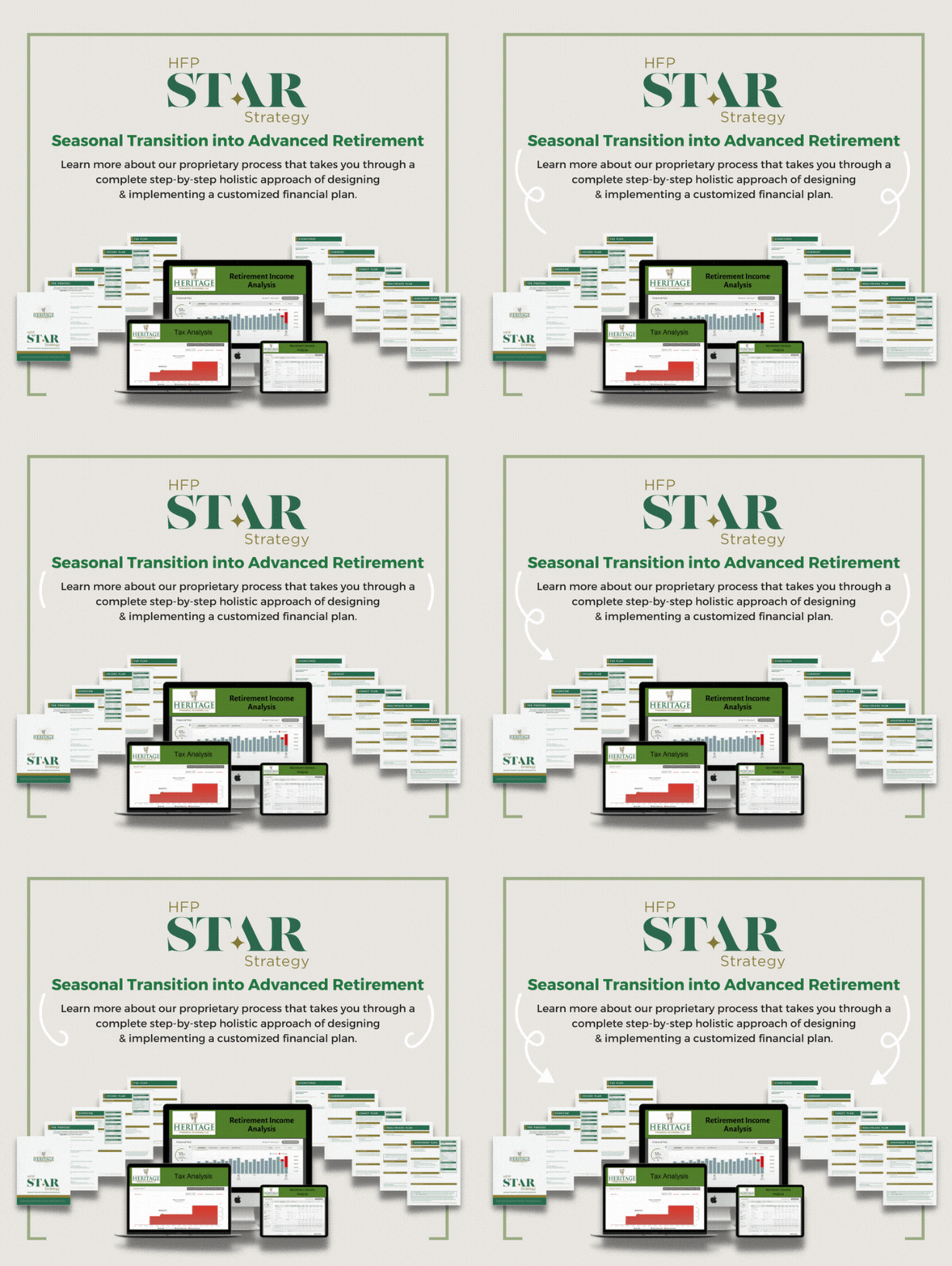
Click here to learn more about our HFP STAR Strategy process.
Sources:
1 . Medicare.gov — Long-Term Care Coverage https://www.medicare.gov/coverage/long-term-care
2 . Medicaid.gov — Long-Term Services & Supports https://www.medicaid.gov/medicaid/long-term-services-supports
3 . Heritage Financial Planning — HFP S.T.A.R. Strategy https://heritagefinancialplanning.net/about/heritage-financial-star-strategy/