



A lot can change in twelve months. Markets move. Interest rates change. Tax rules evolve. Healthcare costs shift. Family circumstances change. Spending looks different than expected. And sometimes, what you want from retirement changes too.
Yet it is surprisingly easy for a retirement plan to remain exactly where it was at the beginning of the year. That is why the end of the year can be a valuable time to conduct a retirement checkup.
The purpose is not to overhaul your entire financial life every December. It is to ask a simpler question: Does the retirement plan you have today still fit the life you are actually living?
At Heritage Financial Planning, we believe retirement planning should be an ongoing process. A plan created several years ago may have been appropriate for that season of life, but retirement itself is constantly evolving. A year-end review can help identify what changed, what stayed on track, and what may deserve attention as you prepare for another year.
Start With Your Retirement Income
One of the first areas to review is income. If you are already retired, compare what you expected to spend this year with what actually happened.
Did your Social Security, pension, retirement-account withdrawals, and other income sources comfortably support your expenses? Did you need to take more from investments than anticipated? Were there large one-time expenses? Did inflation affect your household budget more than expected?
Perhaps the opposite happened. Maybe you spent considerably less than your retirement plan anticipated and have more flexibility than you realized.
Neither result is automatically good or bad. What matters is what the information tells you. Retirement income planning works best when projections are compared with real life.
Look at Where Your Money Actually Went
A retirement budget created before retirement is based partly on assumptions. Once you are actually living in retirement, you have something much more useful: experience.
Look at your major expenses over the past year.
- Housing.
- Travel.
- Healthcare.
- Insurance.
- Transportation.
- Food.
- Family assistance.
- Home repairs.
- Hobbies and entertainment.
- Charitable giving.
Did certain categories consistently cost more than expected? Did others cost less? Your spending patterns may also be changing as retirement progresses.
Someone in the first few years of retirement may spend more on travel and activities. Later, spending may shift toward healthcare, home services, or other priorities. Your financial plan should have room to reflect those changes rather than assuming retirement expenses will remain identical year after year.
Review Your Investment Strategy
A year can also change the makeup of an investment portfolio. Different types of investments do not move at the same pace. As a result, the allocation you started with may no longer be the allocation you have today.
The SEC’s Investor.gov recommends periodically reviewing asset allocation and considering whether rebalancing is appropriate. But a year-end investment review should involve more than asking whether investments went up or down.
Ask:
- Does the portfolio still reflect our risk tolerance?
- Has our need for income changed?
- Do we have sufficient liquidity?
- Has one type of investment become a larger percentage of the portfolio than intended?
- Are we taking more—or less—risk than we realized?
- Has our time horizon changed?
Retirement investing should not be based solely on what markets did over the previous twelve months. Your strategy should be based on what your money needs to accomplish going forward.
Review Retirement-Account Distributions
For retirees subject to Required Minimum Distributions, year-end is also an important time to confirm that applicable distribution requirements have been addressed.
Under current federal rules, many retirement account owners generally begin RMDs at age 73, although the applicable starting age depends on birth year and other circumstances. SECURE 2.0 increases the applicable RMD age to 75 for later age groups under the statutory schedule.
RMD rules can be complicated, particularly in the first distribution year, with inherited accounts, or when multiple retirement accounts are involved. Rather than waiting until the final days of December, retirees subject to RMD requirements should verify that the necessary distributions have been handled appropriately.
Revisit Your Tax Picture
Tax planning should not begin when your return is prepared the following spring. By then, many planning opportunities for the previous tax year may already be gone.
A year-end review provides an opportunity to look at:
- Retirement-account withdrawals.
- Realized investment gains and losses.
- Roth conversions completed during the year.
- Charitable giving.
- Required Minimum Distributions.
- Estimated tax payments.
- Other significant income.
This does not mean every retiree should make a last-minute tax move. The point is to understand what has happened during the year and whether there are financial decisions that should be coordinated with a qualified tax professional before December 31.
Check Your Medicare and Healthcare Strategy
Healthcare deserves its own annual review. Medicare’s annual Open Enrollment Period runs from October 15 through December 7. During this period, eligible Medicare beneficiaries may have opportunities to make changes involving Medicare Advantage or Medicare drug coverage, depending on their current coverage.
Even retirees who are satisfied with their existing plan should review notices from their insurer and understand changes in premiums, networks, formularies, and benefits.
Healthcare needs can also change. New prescriptions. A new diagnosis. More frequent specialist care. A spouse becoming eligible for Medicare. Increasing long-term care concerns. All of these can affect the broader retirement plan.
Review Your Cash Reserves
Unexpected expenses do not disappear when the paycheck stops. If anything, having accessible reserves can become even more important.
How much cash or other highly liquid assets do you have available? Did you use emergency reserves this year? If so, should they be replenished? Are you holding substantially more cash than your plan requires?
A healthy reserve can help prevent every unexpected expense from turning into an investment decision. But too much unproductive cash may also deserve discussion depending on your circumstances. The appropriate amount should reflect your income needs, spending, investments, and comfort level.
Look at Your Beneficiaries and Estate Plan
A retirement checkup should also look beyond your lifetime.
Did anything change in your family this year? Marriage? Divorce? Birth of a grandchild? Death of a family member? Change in relationships? Major change in assets? These events can affect beneficiary designations and estate-planning intentions.
Review beneficiaries on retirement accounts, life insurance policies, and other applicable assets. Consider whether your will, trusts, powers of attorney, healthcare directives, and other estate-planning arrangements should be revisited with your attorney.
An estate plan should evolve with your life just as your retirement plan does.
Don’t Forget About Insurance
Insurance policies can also deserve periodic attention. Life insurance purchased years ago may have a different purpose today. Long-term care coverage may deserve review. Property and casualty insurance should reflect current assets. Even umbrella-liability coverage may need to be reconsidered as circumstances change.
The goal is not automatically to add coverage. It is to determine whether the protection you have still aligns with the risks you face.
Ask the Most Important Question: Has Retirement Changed for You?
Not every important year-end question appears on a financial statement. Maybe you retired this year and discovered that retirement feels different from what you expected.
Maybe you want to travel more. Maybe you want to travel less. Perhaps you are helping grandchildren financially. Maybe taking care of aging parents has become a priority. You might be considering moving, downsizing, working part-time, volunteering, starting a business, or spending more time near family.
Financial planning should support your life—not dictate it. If your goals have changed, the plan may need to change with them.
A Checkup Is Not the Same as Starting Over
Finding something that needs adjustment does not mean your retirement plan has failed. Strong retirement planning is not about creating a plan at 65 that remains untouched until age 90. It is about creating a framework that can adjust as circumstances change.
Sometimes the most appropriate year-end decision is to make no major change at all. Reviewing the plan and confirming that it remains aligned with your needs is still valuable.
Conducting Your Retirement Checkup Through the HFP S.T.A.R. Strategy
At Heritage Financial Planning, our proprietary HFP S.T.A.R. Strategy—Seasonal Transition into Advanced Retirement is designed around the reality that retirement happens in seasons.
Our holistic process integrates five essential areas:
- Income Planning
- Age-Appropriate Investment Strategies
- Tax Planning and Positioning
- Healthcare Strategies
- Legacy Planning
A year-end retirement review provides an opportunity to examine each of these areas together. Has your income changed? Does your investment strategy still fit? Did your tax situation evolve? Have healthcare needs changed? Does your legacy plan still reflect your wishes?
Rather than addressing these questions separately, our HFP S.T.A.R. Strategy helps bring them into one coordinated retirement plan.
As one year ends and another approaches, you do not necessarily need a brand-new retirement strategy. You need to know whether your existing strategy is still doing what you need it to do.
If it has been a while since your retirement plan received a comprehensive review, contact Heritage Financial Planning to schedule an appointment. Our team can help you evaluate what changed this year and determine whether any adjustments should be considered for the year ahead.
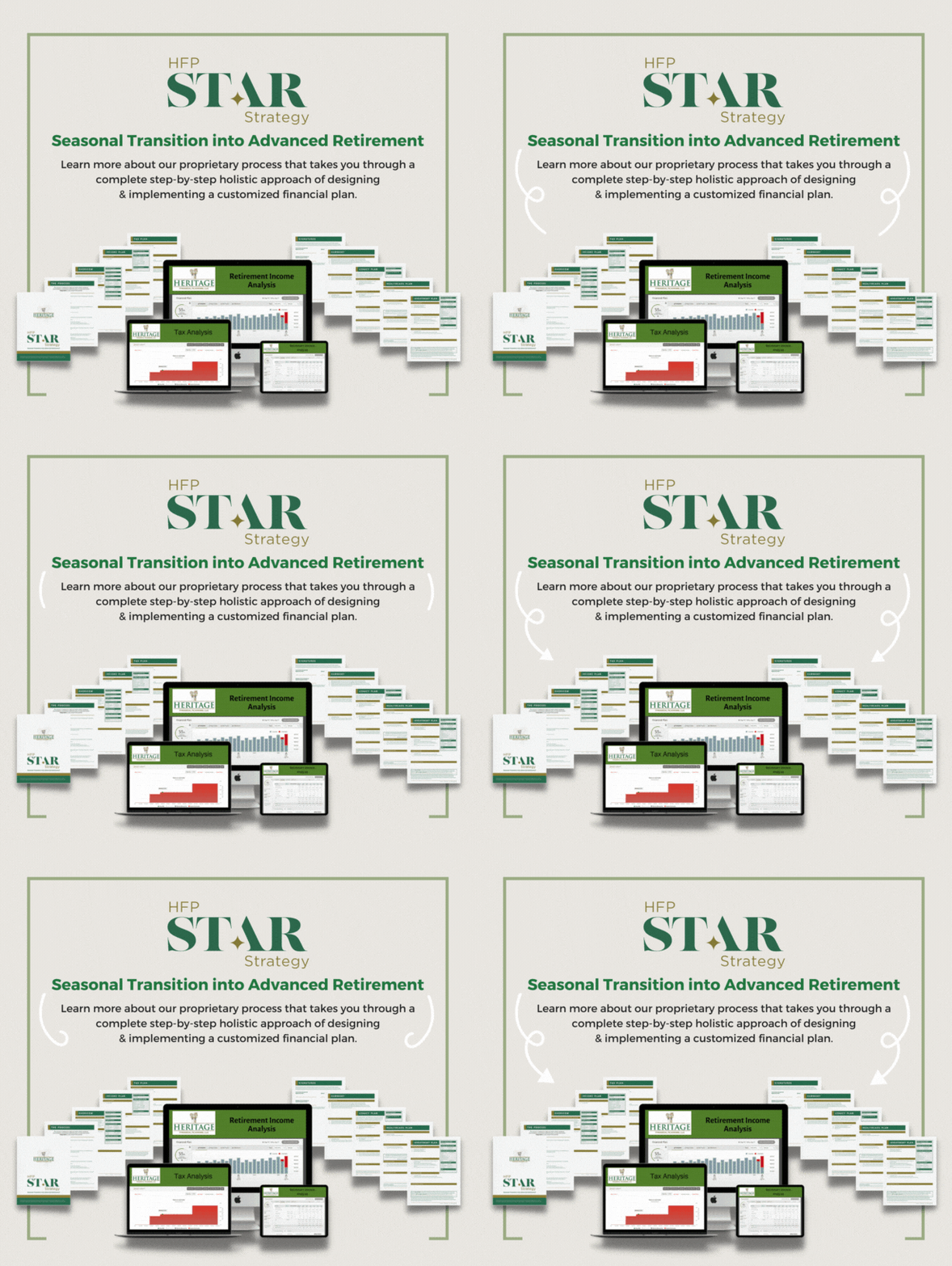
Click here to learn more about our HFP STAR Strategy process.
Sources:
1 . Investor.gov — Tips for 2026: Asset Allocation and Diversification – https://www.investor.gov/introduction-investing/general-resources/news-alerts/alerts-bulletins/investor-bulletins/investorgov-tips-2026-investor-bulletin
2 . Medicare.gov — Medicare Open Enrollment – https://www.medicare.gov/health-drug-plans/open-enrollment
3 . Heritage Financial Planning — HFP S.T.A.R. Strategy – https://heritagefinancialplanning.net/about/heritage-financial-star-strategy/