




For many retirees, taxes feel like something that should become simpler after leaving the workforce. Without a regular paycheck, fewer deductions, and fewer moving parts, it’s easy to assume that tax planning becomes less important.
In reality, the opposite is often true.
Retirement introduces a different kind of financial complexity—one that is less visible but just as impactful. Instead of a single, predictable income source, retirees often rely on multiple streams of income, each with its own tax treatment. Without thoughtful coordination, taxes can quietly reduce the amount of income available to support your lifestyle over time.
Understanding how taxes function in retirement is an important step toward maintaining clarity and control over your financial future.
A Different Kind of Income
During your working years, income typically comes from one primary source: your salary. Taxes are usually withheld automatically, which makes the process feel relatively consistent and manageable. While there may be deductions and adjustments, the overall structure tends to remain stable from year to year.
In retirement, however, income becomes more layered and dynamic.
Rather than relying on a single paycheck, retirees often draw from a combination of Social Security benefits, retirement accounts such as IRAs or 401(k)s, taxable investment accounts, and sometimes pensions or annuities. Each of these income sources is taxed differently, and the way they interact can influence your overall tax picture in ways that are not always immediately obvious.
For example, withdrawals from traditional retirement accounts are generally subject to ordinary income tax, while Roth distributions may be tax-free under certain conditions. Social Security benefits may also become partially taxable depending on your total income. This creates a situation where the structure of your income—not just the amount—plays a meaningful role in how much you ultimately keep.
Why Timing Matters More Than Most People Realize
One of the most overlooked aspects of retirement tax planning is timing. It’s not just about how much income you take, but when and how you take it.
The timing of withdrawals can influence your taxable income in a given year, which in turn can affect whether your Social Security benefits are taxed, whether you cross certain Medicare premium thresholds, and how large your Required Minimum Distributions (RMDs) may become later in retirement.
For instance, spreading withdrawals more evenly over time may help avoid large spikes in taxable income. On the other hand, delaying certain decisions without a plan can result in higher required withdrawals later, which may push you into a higher tax bracket than expected.
These timing decisions are often subtle, but over the course of a long retirement, they can have a meaningful cumulative impact.
Taxes Don’t Go Away—They Shift
A common misconception is that taxes naturally decrease in retirement because earned income stops. While some retirees may see a reduction in taxable income, the overall picture is rarely that simple.
Instead, taxes tend to shift.
Income that was once taxed through payroll may now be replaced by distributions from retirement accounts, investment gains, or Social Security benefits. Each of these sources follows its own set of rules, and those rules can interact in ways that are not always intuitive.
For example, Required Minimum Distributions—mandated by the Internal Revenue Service—can increase taxable income later in retirement. Similarly, capital gains from selling investments may add to your tax burden in certain years. Even healthcare-related costs, such as Medicare premiums, can be influenced by income levels.
These changes highlight an important reality: taxes in retirement are not static. They evolve over time and require ongoing attention.
Why This Matters in Today’s Retirement Landscape
Today’s retirement environment is more complex than it has been in the past. Longer life expectancies mean that retirement can span 25 to 30 years or more, increasing the importance of long-term planning. Over that time, tax laws may change, income needs may evolve, and financial priorities may shift.
In addition, many retirees rely more heavily on personal savings and investment accounts rather than traditional pensions. This places greater responsibility on individuals to manage how and when income is withdrawn.
Without a coordinated approach, it is possible to unintentionally create inefficiencies. For example, retirees may find themselves in higher tax brackets than anticipated, face increased Medicare premiums, or miss opportunities to manage income more effectively across different years.
While none of these outcomes are necessarily immediate or dramatic, they can accumulate over time and affect long-term financial flexibility.
Common Mistakes to Be Aware Of
When it comes to retirement tax planning, certain patterns tend to appear. Some individuals treat all sources of income the same without considering how they are taxed differently. Others focus only on their current tax bill without considering how today’s decisions may affect future years.
In some cases, retirees delay reviewing their withdrawal strategy, assuming that their plan will continue to work as it always has. However, as retirement progresses, the interaction between income sources, tax rules, and personal circumstances can change.
Becoming aware of these tendencies is often the first step toward improving long-term outcomes.
A More Thoughtful Approach to Tax Planning
At Heritage Financial Planning, we view tax planning as an ongoing process rather than a once-a-year activity. Retirement is not a single moment in time—it is a series of phases, each with its own financial considerations.
Through our HFP S.T.A.R. Strategy (Seasonal Transition into Advanced Retirement), we help clients evaluate how income, taxes, and long-term planning decisions work together across those phases. This includes reviewing how income is structured, considering the timing of withdrawals, and identifying opportunities to improve overall efficiency.
The goal is not simply to minimize taxes in any given year, but to support long-term clarity and sustainability.
Moving Forward With Clarity
Taxes do not disappear in retirement—they change. With multiple income sources, evolving rules, and a longer time horizon, thoughtful planning becomes an important part of maintaining financial confidence.
If it has been some time since you reviewed your retirement strategy from a tax perspective, this may be a good opportunity to take a closer look. Even small adjustments can help align your plan more closely with your long-term goals.
At Heritage Financial Planning, we work with individuals and families to create retirement strategies designed to adapt over time. Through our HFP S.T.A.R. Strategy, we provide a structured and personalized approach that helps bring clarity to complex decisions.
If you would like to better understand how your current plan may impact your long-term tax picture, we invite you to schedule a conversation with our team.
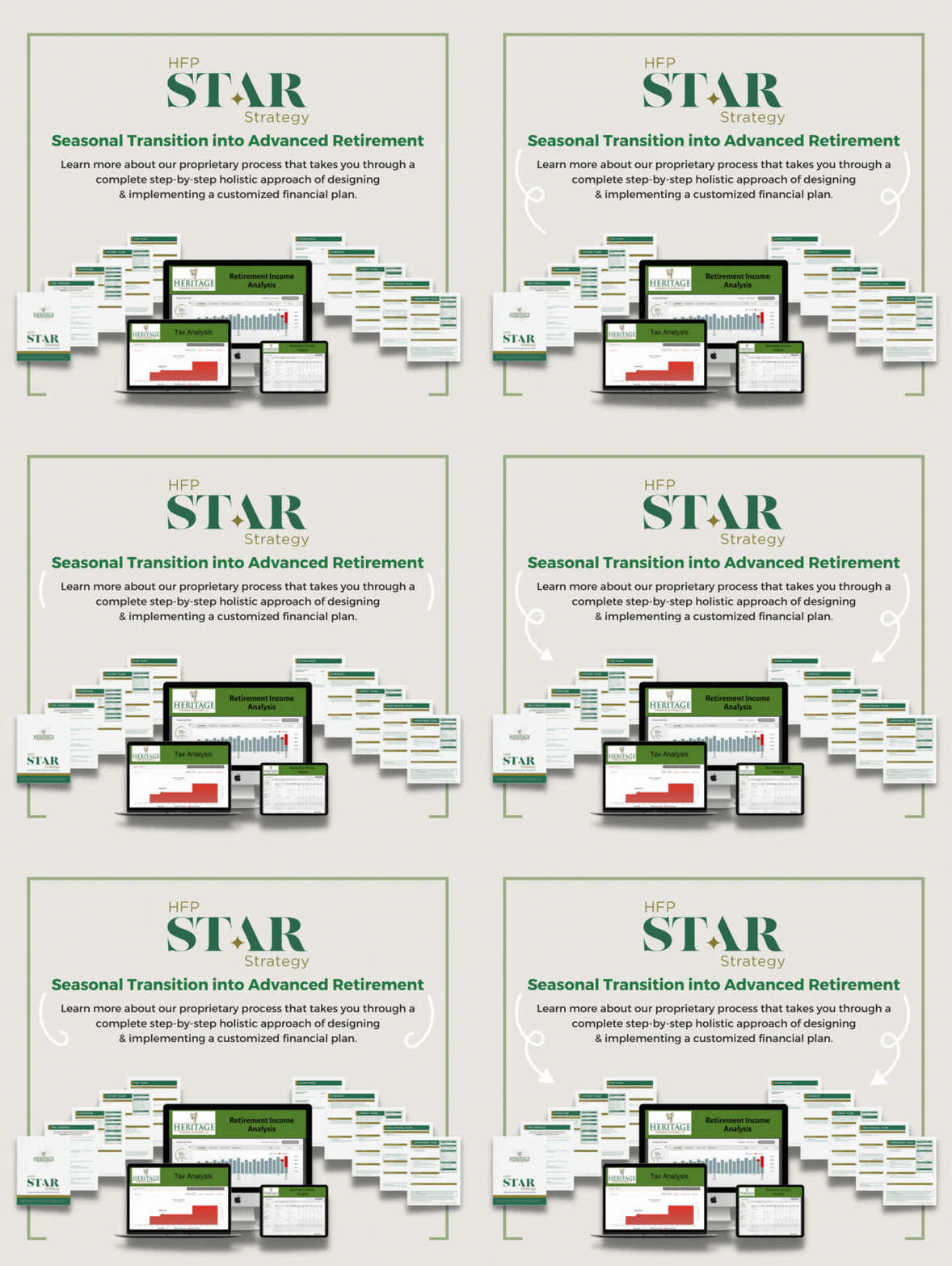
Click here to learn more about our HFP STAR Strategy process.
Sources
- Internal Revenue Service (IRS) – Retirement Plan and IRA Required Minimum Distributions FAQs
https://www.irs.gov/retirement-plans/retirement-plan-and-ira-required-minimum-distributions-faqs - Social Security Administration (SSA) – Benefits Planner: Income Taxes and Your Social Security Benefits
https://www.ssa.gov/benefits/retirement/planner/taxes.html - Fidelity Investments – Taxes in Retirement: What You Need to Know
https://www.fidelity.com/viewpoints/retirement/taxes-in-retirement