




Starting Benefits at Age 62 Can Be the Right Decision for Some Retirees
One of the most important retirement decisions you’ll make is deciding when to begin collecting your Social Security retirement benefits. While many people assume waiting as long as possible is always the best financial strategy, the reality is far more personal. The “right” claiming age depends on your health, income needs, retirement goals, tax situation, and overall financial plan.
You can begin collecting Social Security retirement benefits as early as age 62. However, claiming before your Full Retirement Age (FRA) results in a permanently reduced monthly benefit. Your FRA ranges from age 66 to 67 depending on your year of birth. If you wait beyond your FRA, your benefit increases through delayed retirement credits of approximately 8% per year until age 70, after which there is no additional advantage to delaying.
While waiting often results in a larger monthly benefit, that approach isn’t automatically the best fit for everyone. In fact, there are many situations where claiming Social Security at age 62 may be a practical and financially sound decision.
5 Reasons You Might Choose to Claim Social Security at Age 62
1 . You Need Retirement Income Now
For many retirees, Social Security serves as the foundation of their retirement income. If you’ve stopped working and don’t have enough income from pensions, investment accounts, rental properties, or other sources, claiming benefits at age 62 may provide the financial stability you need.
Although your monthly payment will be lower than if you waited, receiving benefits sooner can help cover everyday expenses such as:
- Housing costs
- Groceries
- Utilities
- Healthcare expenses
- Insurance premiums
In these situations, the immediate cash flow may be far more valuable than a larger benefit several years down the road.
2 . Your Health or Family History Suggests a Shorter Retirement
Social Security is structured so that, on average, individuals receive similar lifetime benefits regardless of when they claim—assuming they live an average lifespan.
However, life doesn’t always follow averages.
If you’re dealing with chronic medical conditions, have a reduced life expectancy, or have a family history of shorter lifespans, waiting until age 70 may not maximize the total amount you receive over your lifetime.
Claiming earlier allows you to begin receiving benefits while you’re still able to enjoy them, which can make financial and personal sense depending on your circumstances.
3 . You Want to Protect Your Retirement Savings
Many retirees assume they should delay Social Security and rely exclusively on their investment accounts. While that strategy works well for some, it isn’t always ideal.
Drawing Social Security earlier may allow you to:
- Reduce withdrawals from your IRA or 401(k)
- Give investment accounts additional time to recover during volatile markets
- Potentially reduce sequence-of-returns risk early in retirement
- Preserve retirement assets for future healthcare expenses or long-term care needs
Every retirement income strategy should evaluate how Social Security coordinates with investment withdrawals rather than viewing each decision separately.
4 . You’re Transitioning Into Retirement With Part-Time Work
Retirement doesn’t always happen overnight. Many people choose to gradually reduce their workload by working part-time or consulting during their early retirement years.
If you claim Social Security before reaching Full Retirement Age while continuing to work, your benefits may be temporarily reduced if your earnings exceed the annual earnings limit.
For 2026, the Social Security earnings test allows beneficiaries below Full Retirement Age to earn up to the annual exempt amount before benefits are temporarily withheld. Importantly, these reductions are not permanently lost. Once you reach Full Retirement Age, your monthly benefit is recalculated to account for those withheld benefits.
This means claiming at 62 while working part-time can still be an effective strategy for individuals who want added income during the transition into retirement.
5 . Your Household May Benefit From a Coordinated Claiming Strategy
Social Security decisions become even more important for married couples.
The timing of one spouse’s benefit can affect the overall retirement income available to the household. Factors that may influence claiming decisions include:
- Differences in lifetime earnings
- Age differences between spouses
- Survivor benefit planning
- Coordinating retirement income with other assets
- Overall tax planning
While many claiming strategies have changed following legislative updates over the past decade, coordinating benefits between spouses remains an important part of comprehensive retirement planning.
Rather than making Social Security decisions independently, couples should evaluate how each claiming age supports their long-term retirement goals together.
There Is No Universal “Best” Age to Claim Social Security
One of the biggest misconceptions about Social Security is that everyone should wait until age 70.
While delaying benefits often results in the highest monthly payment, maximizing your monthly benefit isn’t always the same as maximizing your retirement outcome.
Your ideal claiming strategy depends on many factors, including:
- Current income needs
- Health and longevity expectations
- Retirement savings
- Investment performance
- Tax considerations
- Employment plans
- Family circumstances
- Legacy goals
The best decision is the one that fits your complete financial picture—not simply a generic rule of thumb.
Social Security Should Be Part of a Comprehensive Retirement Income Strategy
Social Security doesn’t exist in a vacuum. It works alongside your investment portfolio, retirement accounts, pensions, taxes, Medicare planning, and overall income strategy.
That’s why we encourage our clients to view Social Security as one piece of a much larger retirement puzzle.
Claiming too early or waiting too long without considering the rest of your financial plan could unintentionally increase taxes, affect Medicare premiums, or create unnecessary withdrawals from your investment accounts.
Taking the time to evaluate how Social Security fits into your broader retirement strategy can help you make a more informed decision with greater confidence.
How the HFP S.T.A.R. Strategy Helps You Build a Smarter Retirement
At Heritage Financial Planning, we understand that retirement isn’t defined by a single milestone—it’s a transition that requires thoughtful planning across every aspect of your financial life. That’s why we’ve developed our HFP S.T.A.R. Strategy (Seasonal Transition into Advanced Retirement) to help individuals and families prepare for retirement with clarity and confidence.
Rather than focusing on one financial decision at a time, our HFP S.T.A.R. Strategy takes a comprehensive approach by coordinating retirement income planning, Social Security claiming strategies, investment management, tax efficiency, Medicare considerations, risk management, and long-term financial goals into one personalized retirement roadmap.
Whether you’re considering claiming Social Security at age 62, waiting until Full Retirement Age, or delaying until age 70, we help evaluate how that decision impacts every other part of your retirement plan. Our goal is to help you make informed decisions that support your lifestyle today while protecting your financial future for years to come.
If you’re approaching retirement and want to determine the Social Security strategy that’s right for your unique situation, we’d love to help. Contact Heritage Financial Planning today to schedule a personalized retirement planning consultation and discover how our HFP S.T.A.R. Strategy can help you transition confidently into retirement.
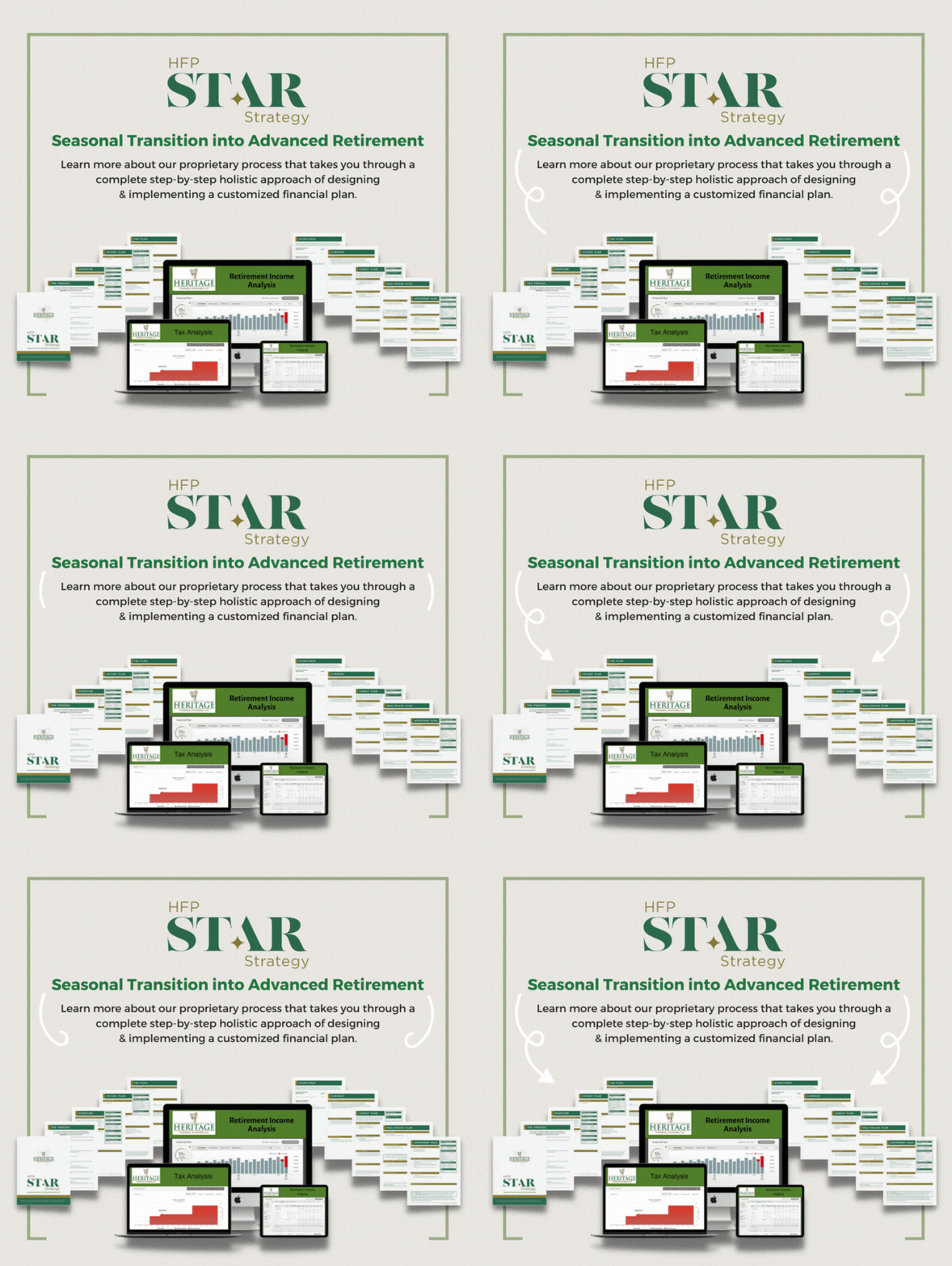
Click here to learn more about our HFP STAR Strategy process.
Sources
1 . Social Security Administration. Retirement Benefits and Full Retirement Age. Updated 2026. https://www.ssa.gov/retirement
2 . Social Security Administration. Retirement Earnings Test and Annual Exempt Amounts. Updated 2026. https://www.ssa.gov/oact/cola/rtea.html
3 . Consumer Financial Protection Bureau. Planning for Retirement Income. https://www.consumerfinance.gov/consumer-tools/retirement/
4 . Employee Benefit Research Institute (EBRI). Retirement Confidence Survey and Retirement Income Research. https://www.ebri.org
5 . Center for Retirement Research at Boston College. Social Security Claiming and Retirement Income Research. https://crr.bc.edu